README v2
pact-ruby v2 implements support for the latest versions of Pact specifications:
- It's based on pact-ffi and pact-ruby-ffi
- It provides a convenient DSL, simplifying the writing of contract tests in Ruby/RSpec
- Writing contract tests with HTTP transports
- Writing contract tests with non-HTTP transports (for example, gRPC)
- Writing contract tests for async messages (Kafka, etc.)
- Verifying contract tests for HTTP/non-HTTP/async message transport
- V4 specification supports mixed pact interactions in a single file.
Architecture
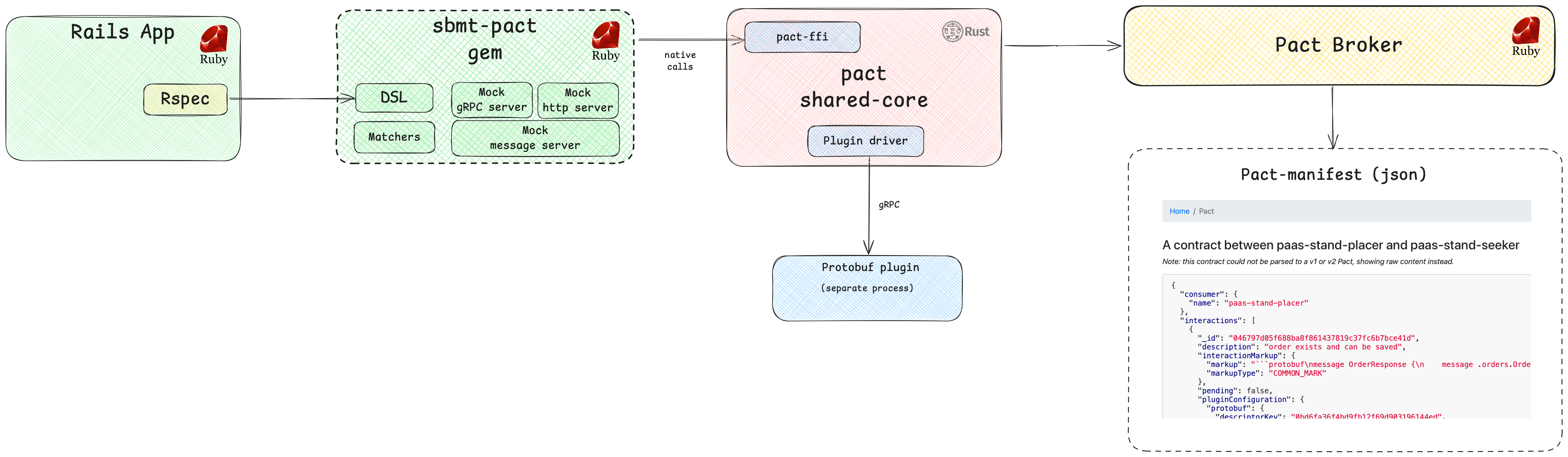
- DSL - implementation of RSpec-DSL for convenient writing of Pact tests
- Matchers - implementation of Pact matchers, which are convenient helpers used in consumer-DSL, encapsulating all the logic for serialization into Pact format
- Mock servers - mock servers that allow for correct execution of provider tests
Installation
The pact/v2 namespace is available in pact-ruby v1.67.0.
It introduces a suite of new depedencies, including a reliance on the pact-ffi and ffi gems.
The native extensions are marked in an optional block, so they are opt in.
 gem "pact"
 gem "pact-ffi", "~> 0.4.28" # add this line, to use the pact/v2 namespace
pact-ffi ships prebuilt binary gems, and does not support platforms outside of the released pact_ffi libraries
| Version | Platform |
|---|---|
| 0.4.28.0 | x86_64-darwin |
| 0.4.28.0 | arm64-darwin |
| 0.4.28.0 | x86_64-linux |
| 0.4.28.0 | aarch64-linux |
| 0.4.28.0 | x86_64-linux-musl |
| 0.4.28.0 | aarch64-linux-musl |
| 0.4.28.0 | x64-mingw32 |
| 0.4.28.0 | x64-mingw-ucrt |
Usage
For each type of interaction (due to their specific features), a separate version of DSL has been implemented. However, the general principles remain the same for each type of interaction.
Place your consumer tests under
spec/pact/provider/**
it's not an error: consumer tests contain providers subdirectory (because we're testing against different providers)
# Declaration of a consumer test, always include the :pact tag
# This is used in CI/CD pipelines to separate Pact tests from other RSpec tests
# Pact tests are not run as part of the general RSpec pipeline
RSpec.describe "SomePactConsumerTestForAnyTransport", :pact do
  # declaration of the type of interaction - here we determine which consumer and provider interact on which transport
  has_http_pact_between "CONSUMER-NAME", "PROVIDER-NAME"
  # or
  has_grpc_pact_between "CONSUMER-NAME", "PROVIDER-NAME"
  # or
  has_message_pact_between "CONSUMER-NAME", "PROVIDER-NAME"

  # the context for one of the interactions, for example GET /api/v2/stores
  context "with GET /api/v2/stores" do
      let(:interaction) do
        # creating a new interaction - within which we describe the contract
        new_interaction
          # if you need to save any metadata for subsequent use by the test provider,
          # for example, specify the entity ID that will need to be moved to the database in the test provider
          # we use the provider states, see more at https://docs.pact.io/getting_started/provider_states
          .given("UNIQUE PROVIDER STATE", key1: value1, key2: value2)
          # the description of the interaction, used for identification inside the package binding,
          # is optional in some cases, but it is recommended to always specify
          .upon_receiving("UNIQUE INTERACTION DESCRIPTION")
          # the description of the request using the matchers
          # the name and parameters of the method differ for different transports
          .with_request(...)
          # the description of the response using the matchers
          # the name and parameters of the method differ for different transports
          .will_respond_with(...)
          # further, there are differences for different types of transports,
          # for more information, see the relevant sections of the documentation
      end

      it "executes the pact test without errors" do | mock_server |
        interaction.execute do
          # the url of the started mock server, you should pass this into your api client in the next step
          mock_server_url = mock_server.url
          # here our client is called for the API being tested
          # in this context, the client can be: http client, grpc client, kafka consumer
          expect(make_request).to be_success
        end
      end
    end
  end
Common DSL Methods:
new_interaction- initializes a new interactiongiven- allows specifying a provider state with or without parameters, for more details see provider_statesupon_receiving- allows specifying the name of the interaction
Multiple interactions can be declared within a single rspec example, in order to call the mock server
execute_http_pact: Use this instead ofinteraction.execute
HTTP consumers
Specific DSL methods:
with_request({method: string, path: string, headers: kv_hash, body: kv_hash})- request definitionwill_respond_with({status: int, headers: kv_hash, body: kv_hash})- response definition
More at http_client_spec.rb
gRPC consumers
Specific DSL methods:
with_service(PROTO_PATH, RPC_SERVICE_AND_ACTION)- specifies the contract used, PROTO_PATH is relative from the app rootwith_request(request_kv_hash)- request definitionwill_respond_with(response_kv_hash)- response definition
More at grpc_client_spec.rb
Message consumers
Specific DSL methods:
with_headers(kv_hash)- message-headers definition; you can use matcherswith_metadata(kv_hash)- message-metadata definition (special keys arekeyandtopic, where, respectively, you can specify the matchers for the partitioning key and the topic
Next, the specifics are one of two options for describing the format:
JSON (to describe a message in a JSON representation):
with_json_contents(kv_hash)- message format definition
PROTO (to describe the message in the protobuf view):
with_proto_class(PROTO_PATH, PROTO_MESSAGE_NAME)- specifies the contract used, PROTO_PATH is relative to the root, PROTO_MESSAGE_NAME is the name of the message used from the proto filewith_proto_contents(kv_hash)- message format definition
More at message_spec.rb
Kafka consumers
Specific DSL methods:
with_headers(kv_hash)- message-headers definition; you can use matcherswith_metadata(kv_hash)- message-metadata definition (special keys arekeyandtopic, where, respectively, you can specify the matchers for the partitioning key and the topic
Next, the specifics are one of two options for describing the format:
JSON (to describe a message in a JSON representation):
with_json_contents(kv_hash)- message format definition
PROTO (to describe the message in the protobuf view):
with_proto_class(PROTO_PATH, PROTO_MESSAGE_NAME)- specifies the contract used, PROTO_PATH is relative to the root, PROTO_MESSAGE_NAME is the name of the message used from the proto filewith_proto_contents(kv_hash)- message format definition
More at kafka_spec.rb
Requires the following gems, to use this wrapper
- sbmt-kafka_consumer
- sbmt-kafka_provider
Matchers
Matchers are special helper methods that allow you to define rules for matching request/response parameters at the level of the pact manifest. The matchers are described in the Pact specifications. In this gem, the matchers are implemented as RSpec helpers.
For details of the implementation, see matchers.rb
match_exactly(sample)- match the exact value specified in the samplematch_type_of(sample)- match the data type (integer, string, boolean) specified in the samplematch_include(sample)- match a substringmatch_any_string(sample)- match any string, because of the peculiarities, null and empty strings will also be matched herematch_any_integer(sample)- match any integermatch_any_decimal(sample)- match any float/doublematch_any_number(sample)- match any integer/float/doublematch_any_boolean(sample)- match any true/falsematch_uuid(sample)- match any UUID (match_regexis used under the hood)match_regex(regex, sample)- match by regexpmatch_datetime(format, sample)- match any datetimematch_iso8601(sample)- match datetime in ISO8601 (the matcher does not fully comply with ISO8601, matches only the most common variants,match_regexis used under the hood)match_date(format, sample)- match any date (rust datetime)match_time(format, sample)- match any time (rust datetime)match_each(template)- match all the elements of the array according to the specified template, you can use it for nested elementsmatch_each_regex(regex, sample)- match all array elements by regex, used for arrays with string elementsmatch_each_key(template, key_matchers)- match each hash key according to the specified templatematch_each_value(template)- match each hash value according to the specified template, can be used for nested elementsmatch_each_kv(template, key_matchers)- match all the keys/values of Hash according to the specified template and key_matchers, can be used for nested elements
See the different uses of the matchers in matchers_spec.rb
Generators
Generators are helper methods that allow you to specify dynamic values in your contract tests. These values are generated at runtime, making your contracts more flexible and robust. Below are the available generator methods:
For details of the implementation, see matchers.rb
generate_random_int(min:, max:)- Generates a random integer between the specifiedminandmax.generate_random_decimal(digits:)- Generates a random decimal number with the specified number ofdigits.generate_random_hexadecimal(digits:)- Generates a random hexadecimal string with the specified number ofdigits.generate_random_string(size:)- Generates a random string of the specifiedsize.generate_uuid(example: nil)- Generates a random UUID. Optionally, provide anexamplevalue.generate_date(format: nil, example: nil)- Generates a date string in the specifiedformat. Optionally, provide anexample.generate_time(format: nil)- Generates a time string in the specifiedformat.generate_datetime(format: nil)- Generates a datetime string in the specifiedformat.generate_random_boolean- Generates a random boolean value (trueorfalse).generate_from_provider_state(expression:, example:)- Generates a value from the provider state using the givenexpressionandexamplevalue. Allows templating of url and query paths with values only know at provider verification time.generate_mock_server_url(regex: nil, example: nil)- Generates a mock server URL. Optionally, specify aregexmatches and/or anexamplevalue.
These generators can be used in your DSL definitions to provide dynamic values for requests, responses, or messages in your contract tests.
Generator Examples
  .with_request(
    method: :get,
    path: generate_from_provider_state(
      expression: '/alligators/${alligator_name}',
      example: '/alligators/Mary'),
    headers: headers)

...

  body: {
    _links: {
      :'pf:publish-provider-contract' => {
        href: generate_mock_server_url(
          regex: ".*(\\/provider-contracts\\/provider\\/.*\\/publish)$",
          example: "/provider-contracts/provider/{provider}/publish"
        ),
        boolean: generate_random_boolean,
        integer: generate_random_int(min: 1, max: 100),
        decimal: generate_random_decimal(digits: 2),
        hexidecimal: generate_random_hexadecimal(digits: 8),
        string: generate_random_string(size: 10),
        uuid: generate_uuid,
        date: generate_date(format: "yyyyy.MMMMM.dd GGG"),
        time: generate_time(),
        datetime: generate_datetime(format: "%Y-%m-%dT%H:%M:%S%z")
      }
    }
  }
Provider verification
Place your provider verification file under
spec/pact/consumers/**
it's not an error: provider tests contain consumers subdirectory (because we're verifying against different consumer)
Provider verification options
            @provider_name = provider_name
            @log_level = opts[:log_level] || :info
            @pact_dir = opts[:pact_dir] || nil
            @provider_setup_port = opts[:provider_setup_port] || 9001
            @pact_proxy_port = opts[:provider_setup_port] || 9002
            @pact_uri = ENV.fetch("PACT_URL", nil) || opts.fetch(:pact_uri, nil)
            @publish_verification_results = ENV.fetch("PACT_PUBLISH_VERIFICATION_RESULTS", nil) == "true" || opts.fetch(:publish_verification_results, false)
            @provider_version = ENV.fetch("PACT_PROVIDER_VERSION", nil) || opts.fetch(:provider_version, nil)
            @provider_build_uri = ENV.fetch("PACT_PROVIDER_BUILD_URL", nil) || opts.fetch(:provider_build_uri, nil)
            @provider_version_branch = ENV.fetch("PACT_PROVIDER_BRANCH", nil) || opts.fetch(:provider_version_branch, nil)
            @provider_version_tags = ENV.fetch("PACT_PROVIDER_VERSION_TAGS", nil) || opts.fetch(:provider_version_tags, [])
            @consumer_version_tags = ENV.fetch("PACT_CONSUMER_VERSION_TAGS", nil) || opts.fetch(:consumer_version_tags, [])
            @consumer_version_selectors = ENV.fetch("PACT_CONSUMER_VERSION_SELECTORS", nil) || opts.fetch(:consumer_version_selectors, nil)
            @enable_pending = ENV.fetch("PACT_VERIFIER_ENABLE_PENDING", nil) == "true" || opts.fetch(:enable_pending, false)
            @include_wip_pacts_since = ENV.fetch("PACT_INCLUDE_WIP_PACTS_SINCE", nil) || opts.fetch(:include_wip_pacts_since, nil)
            @fail_if_no_pacts_found = ENV.fetch("PACT_FAIL_IF_NO_PACTS_FOUND", nil) == "true" || opts.fetch(:fail_if_no_pacts_found, true)
            @consumer_branch = ENV.fetch("PACT_CONSUMER_BRANCH", nil) || opts.fetch(:consumer_branch, nil)
            @consumer_version = ENV.fetch("PACT_CONSUMER_VERSION", nil) || opts.fetch(:consumer_version, nil)
            @consumer_name = opts[:consumer_name]
            @broker_url = ENV.fetch("PACT_BROKER_BASE_URL", nil) || opts.fetch(:broker_url, nil)
            @broker_username = ENV.fetch("PACT_BROKER_USERNAME", nil) || opts.fetch(:broker_username, nil)
            @broker_password = ENV.fetch("PACT_BROKER_PASSWORD", nil) || opts.fetch(:broker_password, nil)
            @broker_token = ENV.fetch("PACT_BROKER_TOKEN", nil) || opts.fetch(:broker_token, nil)
            @verify_only = [ENV.fetch("PACT_CONSUMER_FULL_NAME", nil)].compact || opts.fetch(:verify_only, [])
Single transport providers
# frozen_string_literal: true

require "pact_broker"
require "pact_broker/app"
require "rspec/mocks"
include RSpec::Mocks::ExampleMethods
require_relative "../../service_consumers/hal_relation_proxy_app"

PactBroker.configuration.base_urls = ["http://example.org"]

pact_broker = PactBroker::App.new { |c| c.database_connection = PactBroker::TestDatabase.connection_for_test_database }
app_to_verify = HalRelationProxyApp.new(pact_broker)

require "pact"
require "pact/v2/rspec"
require_relative "../../service_consumers/shared_provider_states"
RSpec.describe "Verify consumers for Pact Broker", :pact_v2 do

  http_pact_provider "Pact Broker", opts: {

    # rails apps should be automatically detected
    # if you need to configure your own app, you can do so here

    app: app_to_verify,
    # start rackup with a different port. Useful if you already have something
    # running on the default port *9292*
    http_port: 9393,

    # Set the log level, default is :info

    log_level: :info,

    fail_if_no_pacts_found: true,

    # Pact Sources

    # 1. Local pacts from a directory

    # Default is pacts directory in the current working directory
    # pact_dir: File.expand_path('../../../../consumer/spec/internal/pacts', __dir__),

    # 2. Broker based pacts

    # Broker credentials

    # broker_username: "pact_workshop", # can be set via PACT_BROKER_USERNAME env var
    # broker_password: "pact_workshop", # can be set via PACT_BROKER_PASSWORD env var
    # broker_token: "pact_workshop", # can be set via PACT_BROKER_TOKEN env var

    # Remote pact via a uri, traditionally triggered via webhooks
    # when a pact that requires verification is published

    # 2a. Webhook triggered pacts
    # Can be a local file or a remote URL
    # Most used via webhooks
    # Can be set via PACT_URL env var
    # pact_uri: File.expand_path("../../../pacts/pact.json", __dir__),
    pact_uri: "https://raw.githubusercontent.com/YOU54F/pact_broker-client/refs/heads/feat/pact-ruby-v2/spec/pacts/Pact%20Broker%20Client%20V2-Pact%20Broker.json",
    # pact_uri: "https://raw.githubusercontent.com/YOU54F/pact_broker-client/refs/heads/feat/pact-ruby-v2/spec/pacts/pact_broker_client-pact_broker.json",
    # pact_uri: "http://localhost:9292/pacts/provider/Pact%20Broker/consumer/Pact%20Broker%20Client/version/96532124f3a53a499276c69ff2df785b8377588e",

    # 2b. Dynamically fetched pacts from broker

    # i. Set the broker url
    # broker_url: "http://localhost:9292", # can be set via PACT_BROKER_URL env var

    # ii. Set the consumer version selectors
    # Consumer version selectors
    # The pact broker will return the following pacts by default, if no selectors are specified
    # For the recommended setup, you dont _actually_ need to specify these selectors in ruby
    # consumer_version_selectors: [{"deployedOrReleased" => true},{"mainBranch" => true},{"matchingBranch" => true}],

    # iii. Set additional dynamic selection verification options
    # additional dynamic selection verification options
    enable_pending: true,
    include_wip_pacts_since: "2021-01-01",

    # Publish verification results to the broker
    publish_verification_results: ENV["PACT_PUBLISH_VERIFICATION_RESULTS"] == "true",
    provider_version: `git rev-parse HEAD`.strip,
    provider_version_branch: `git rev-parse --abbrev-ref HEAD`.strip,
    provider_version_tags: [`git rev-parse --abbrev-ref HEAD`.strip],
    # provider_build_uri: "YOUR CI URL HERE - must be a valid url",

  }

  before_state_setup do
    PactBroker::TestDatabase.truncate
  end

  after_state_teardown do
    PactBroker::TestDatabase.truncate
  end

  shared_provider_states

end
Multiple transport providers
You may have a consumer pact which consumes multiple transport protocols, if they are using pact specification v4.
In order to validate an entire pact in a single test run, you will need to configure each transport as appropriate.
# frozen_string_literal: true

require "pact/v2/rspec"

RSpec.describe "Pact::V2::Consumers::Http", :pact_v2 do
  mixed_pact_provider "pact-v2-test-app", opts: {
    http: {
      http_port: 3000,
      log_level: :info,
      pact_dir: File.expand_path('../../pacts', __dir__),
    },
    grpc: {
      grpc_port: 3009
    },
    async: {
      message_handlers: {
        # "pet message as json" => proc do |provider_state|
        #   pet_id = provider_state.dig("params", "pet_id")
        #   with_pact_producer { |client| PetJsonProducer.new(client: client).call(pet_id) }
        # end,
        # "pet message as proto" => proc do |provider_state|
        #   pet_id = provider_state.dig("params", "pet_id")
        #   with_pact_producer { |client| PetProtoProducer.new(client: client).call(pet_id) }
        # end
      }
    }
  }

  handle_message "pet message as json" do |provider_state|
    pet_id = provider_state.dig("params", "pet_id")
    with_pact_producer { |client| PetJsonProducer.new(client: client).call(pet_id) }
  end

  handle_message "pet message as proto" do |provider_state|
    pet_id = provider_state.dig("params", "pet_id")
    with_pact_producer { |client| PetProtoProducer.new(client: client).call(pet_id) }
  end

end
Development & Test
Setup
bundle install
Run unit tests
bundle exec rake spec:v2
Run pact tests
The Pact tests are not run within the general rspec pipeline, they need to be run separately, see below
Consumer tests
bundle exec rspec -t pact spec/pact/providers/**/*_spec.rb
or
bundle exec rake pact:v2:spec
NOTE If you have never run it, you need to run it at least once to generate the pact files that will be used in provider tests (below)
Provider tests
bundle exec rspec -t pact spec/pact/consumers/*_spec.rb
or
bundle exec rake pact:v2:spec
Examples
Migration
-
add
gem "pact-ffi", "~> 0.4.28"to Gemfile, or Gemspec -
pact ruby v2 uses activesupport classes, so you may need to add
-
gem 'combustion'to load active support during tests -
add a pact helper to load it
require "combustion"
begin
  Combustion.initialize! :action_controller do
    config.log_level = :fatal if ENV["LOG"].to_s.empty?
  end
rescue => e
  # Fail fast if application couldn't be loaded
  warn "💥 Failed to load the app: #{e.message}\n#{e.backtrace.join("\n")}"
  exit(1)
end
-
-
Add a new rake task
- require your helper file created above
- add a tag, we will use
pact_v2to namespace away from our existingpacttagged tests
RSpec::Core::RakeTask.new('spec:v2') do |task|
  task.pattern = 'spec/pact/providers/**/*_spec.rb'
  task.rspec_opts = ['-t pact_v2', '--require rails_helper']
end -
File paths have moved for consumer tests, and provider verification tasks
- consumer test location
- pact v1
spec/service_providers - pact v2 -
spec/pact/providers
- pact v1
- provider verification location
- pact v1
spec/service_consumers - pact v2 -
spec/pact/consumers
- pact v1
- consumer test location
The following projects were designed for pact-ruby-v1 and have been migrated to pact-ruby-v2. They can serve as an example of the work required.
- pact broker client
- pact broker
- animal service
- zoo app
- message consumer/provider
- e2e http consumer/provider
- pact-ruby-e2e-example
- Plus http, message, grpc & mixed consumer & provider examples
- pact-ruby-e2e-example
Demos
The demos are stored in this codebase for regression test, but exist as standalone in https://github.com/pact-foundation/pact-ruby-e2e-example
- http consumer http_client_spec.rb
- kafka consumer with pact-ruby wrapper kafka_spec.rb
- message consumer message_spec.rb
- plugin consumer http plugin_matt_http_spec.rb
- plugin consumer http plugin_matt_sync_message_spec.rb
- plugin consumer http plugin_matt_async_message_spec.rb
- plugin consumer http plugin_matt_http_spec.rb
- grpc consumer with pact-ruby wrapper grpc_client_spec.rb
- grpc consumer using direct plugin interface plugin_grpc_sync_message_spec.rb
- mixed(http/kafka/grpc) provider multi_spec.rb
